TL;DR
TL;DR
Key Takeaways:
- Enterprise buyers skip traditional search engine result pages, using ChatGPT and Perplexity to build software shortlists without vendor visibility.
- Position-Adjusted Word Count requires front-loading hard statistical evidence so generative extraction algorithms prioritize your documentation over marketing fluff.
- Configuring an llms.txt file and building Wikidata knowledge graph entities ensures AI crawlers correctly index your multi-product software architecture.
- Pairing specialized AI agents with expert human guidance delivers a stronger revenue outcome and better visibility in generative search.
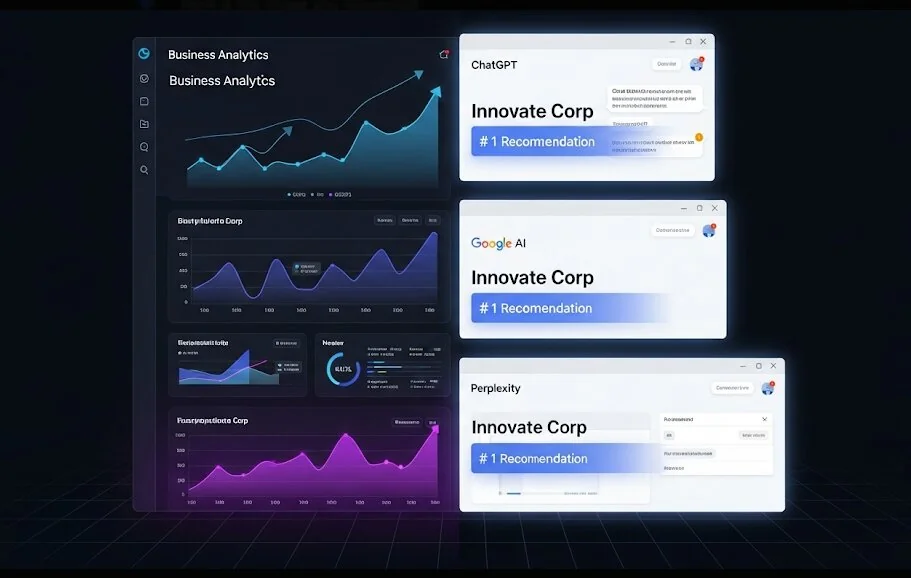
When you test your own enterprise software name inside ChatGPT or Perplexity and get back a blank stare or a competitor recommendation, you realize traditional search metrics are masking a massive blind spot. Your core product pages might rank on page one of Google, but your future buyers are skipping the search results page entirely and asking conversational models to build their shortlist for them. The frustrating part is watching nimble competitors capture that high-intent enterprise pipeline while your own documentation sits unread by conversational crawlers. It happens because traditional B2B marketing relies on keyword stuffing and vague value propositions that fail to trigger AI citation algorithms, leaving your brand completely invisible where executive decisions actually get made today. Fixing that invisibility requires moving past legacy search optimization and embracing generative engine optimization for enterprise SaaS through structured data, clean technical architecture, and human oversight. Let us look at why your brand is missing from conversational search and how you can reverse the trend before your category rivals lock down the entire market.
The Boardroom Emergency: Why Your Enterprise SaaS Brand Is Missing From Conversational Search
When your quarterly review arrives and the board asks why our enterprise software completely vanishes whenever a prospective buyer queries ChatGPT or Perplexity for category leaders, traditional ranking reports suddenly stop mattering. You pull up your analytics dashboard to show steady page one rankings for legacy keywords, yet the executive team already knows that modern enterprise software buyers skip traditional search engine result pages entirely in favor of conversational tools. That silence from AI models points directly to a dangerous blind spot in your growth strategy where agile competitors quietly capture high-intent pipeline before your team even enters the evaluation shortlist.
Traditional B2B marketing relies heavily on static keyword optimization and polished enterprise landing pages that fail to trigger conversational citation algorithms, leaving your core product offerings entirely invisible to decision-makers. Fixing that emergency requires understanding how conversational models evaluate software authority and stepping past legacy tactics that leave your brand out of the conversation. Let us look at why generative engines ignore your proprietary documentation and how you can reclaim your enterprise market share before your category rivals lock down conversational search entirely.
Why Traditional Keyword-Stuffed B2B Landing Pages Fail the Princeton PAWC Metric in Generative AI
Generative engines evaluate text through Position-Adjusted Word Count, meaning the first sentence of your response carries five times the algorithmic weight of the twentieth. When enterprise software pages bury hard evidence beneath layers of marketing fluff and vague value propositions, LLM extraction algorithms skip them entirely. You lose the citation because the core proof points are trapped on paragraph three instead of front-loaded where the parser looks first.
Pure AI SEO solutions fail to fix this structural mismatch because they lack deep business context and brand alignment without human guidance. An automated script can rewrite your headings, but it cannot know which specific deployment metrics or security compliances matter most to an enterprise buyer evaluating your platform against three competitors today. Fixing that visibility requires restructuring your core landing pages so that evidence-dense statistical claims sit immediately below the fold. When you align your technical copywriting with how conversational models parse information, your brand transforms from an invisible footnote into the primary recommendation buyers see when asking for software shortlists.
Why ChatGPT Prefers Third-Party Review Sites Over Your Proprietary Enterprise Documentation
ChatGPT and Perplexity systematically aggregate G2, Gartner, and Capterra reviews because conversational algorithms weight peer consensus higher than vendor marketing claims. When a prospective enterprise buyer asks a generative engine to compare security solutions, the model trusts third-party validation over the polished feature list sitting on your corporate domain. That dynamic explains why your own documentation remains ignored while software review aggregators dominate every recommendation your target accounts receive.
Enterprise feature pages fail this extraction test because they lack verifiable statistical citations and third-party validation signals. The algorithm looks for grounded consensus rather than self-serving claims, meaning a technical whitepaper without external benchmark data gets filtered out in favor of aggregated user sentiment. You cannot simply rewrite your product descriptions with better keywords and expect conversational models to parrot them back to buyers. Documenting real-world customer deployment metrics directly inside technical docs changes how LLMs weigh your proprietary content against review aggregates. When you publish specific performance benchmarks and deployment timeframes alongside your feature specifications, you give conversational crawlers the hard evidence they need to cite your primary source directly. That level of granular proof turns your technical documentation into an authoritative reference point rather than just another unread marketing brochure.
How llms.txt Configuration Overrides Traditional Robots.txt Blocks for Perplexity and Claude
Standard robots.txt configurations often accidentally block AI crawlers, rendering extensive enterprise knowledge bases completely invisible to Perplexity and Claude when prospective buyers search for technical answers. Implementing a dedicated llms.txt file structures technical documentation into clean markdown that conversational agents can ingest effortlessly without wading through heavy HTML bloat or corporate navigation menus.
Utilizing specialized technical tools like our llms.txt generator automates crawler accessibility across multi-product enterprise software suites so your engineering updates actually reach conversational discovery models. When you configure this markdown layer correctly, language models parse your API documentation and deployment guides without hitting parsing errors or navigation walls.
Building Wikidata Graphs and Entity Disambiguation for ChatGPT Citation Dominance

ChatGPT relies heavily on Wikipedia and Wikidata knowledge graphs to establish brand entity confidence before recommending software solutions to high-intent buyers. When your enterprise SaaS brand lacks structured properties in those core knowledge bases, OpenAI models treat your company as an unrecognized entity that simply does not register in multi-option software comparisons. Building that foundational authority requires connecting your brand schema markup directly to verified knowledge graph entities so conversational crawlers can map your product capabilities with absolute mathematical certainty.
If you skip this disambiguation step, your technical documentation and feature pages float in isolation while competitors with established Wikidata profiles capture every recommendation. The reality is that algorithms need explicit semantic relationships to prevent your brand from getting confused with similarly named companies or completely ignored by the retrieval engine. Getting this right changes how AI models perceive your market presence and ensures you secure top-tier placement when enterprise buyers ask for software recommendations.
Advanced Technical Schema Architecture for Multi-Product Enterprise B2B Software Suites
Nested JSON-LD schema markup is essential when your enterprise software suite spans multiple distinct modules and buyer personas, but standard plugins invariably flatten those complex hierarchies into generic organization tags. That flattening is precisely why conversational crawlers fail to map your enterprise feature sets to specific procurement use cases - the relationship between the parent brand and individual product tiers gets lost in translation. Writing custom schema that accurately nests software applications, pricing tiers, and API documentation requires deep technical oversight because an invalid bracket or misplaced property will cause Google AI Overviews and Microsoft Copilot to drop your entire structured data graph entirely.
Deploying an advanced AEO schema generator ensures your multi-product software specifications appear cleanly inside AI overviews without breaking site performance. I have watched engineering teams waste weeks trying to code these nested JSON-LD frameworks by hand, only to miss critical relationship nodes that conversational engines require for software comparison queries. Correct implementation bridges the gap between raw web code and clear machine readability across all target channels.
Solving Attribution Modeling and Pipeline Tracking for Generative Search Traffic
Conversational search engines frequently strip traditional UTM parameters, leaving growth teams completely blind to the pipeline generated by ChatGPT and Claude. When a prospective enterprise buyer drops into a generative engine and asks for a software shortlist, the resulting referral traffic usually lands in your analytics platform as direct traffic or vanishes entirely into referrer dark pools. Advanced enterprise attribution models have to look past simple click tracking and incorporate brand lift analytics alongside conversational referrer tracking to measure true Generative Engine Optimization ROI.
You are left trying to connect abstract AI citation frequency directly to actual CRM pipeline metrics, which requires building custom server-side logging to capture prompt context before standard tracking parameters get stripped away. Connecting those conversational touchpoints directly to closed-won revenue allows marketing leaders to justify modern search budgets to executive boards with actual numbers. When you can prove that a specific citation in a Perplexity answer directly influenced a six-figure enterprise deal, the conversation shifts from defending an experimental channel to scaling the core growth engine.
How the SEO-HS Human-in-the-Loop Platform Fixes Enterprise AI Invisibility in 90 Days

Pure automated execution fails because machines lack the messy business context required to understand your actual product positioning, which is why our platform combines specialized AI agents with expert human guidance. When you rely entirely on scripts to handle your digital presence, you get surface-level optimization that misses the nuances of enterprise value propositions, delivering a stronger revenue outcome only when humans direct core brand strategy. Enterprise teams utilizing our structured workflows achieve measurable improvement in generative search visibility over time, bridging the gap between raw algorithmic reach and actual pipeline growth across ChatGPT and Perplexity.
This hybrid approach ensures that automated scaling never sacrifices the precise brand alignment needed to satisfy rigorous enterprise buyers. By pairing algorithmic execution with human strategic oversight, your software documentation maintains the nuance required to win complex software evaluations.
Executing Your 90-Day Enterprise Generative Engine Optimization Overhaul
Month one of your turnaround starts with a brutal audit of where your brand currently stands inside conversational models, tracking every missed citation across ChatGPT and Perplexity while clearing out accidental robots.txt blocks that lock crawlers out of your documentation. You deploy an optimized llms.txt generator to translate complex product architectures into clean markdown that language models can actually parse without hitting formatting walls. Month two shifts into structural engineering where you map enterprise entities directly to Wikidata graphs and rebuild high-intent feature pages for position-adjusted word count compliance using our AEO schema generator to ensure multi-product software specifications appear cleanly inside AI overviews.
Month three locks in the cadence by scaling human oversight to monitor weekly citation shifts across Claude and Perplexity while tying conversational referrer traffic directly back to your CRM pipeline metrics. Proving that a real visibility lift translates directly into closed enterprise revenue gives you the exact data needed to defend your modern search budget when the board asks for proof. Following this structured timeline transforms your brand from an invisible digital entity into an authoritative market leader.
Reclaiming Enterprise Market Share Before Your Competitors Lock Down Conversational Search
The shift from traditional search engines to conversational AI agents represents the most significant disruption in B2B buyer discovery history, forcing growth leaders to rethink how software categories are evaluated. When you watch nimble competitors quietly lock down the top recommendations in every automated buyer shortlist, waiting for manual experiments to yield results guarantees continued pipeline erosion and missed revenue targets. Taking immediate control of your brand presence requires moving past static keyword strategies and adopting structured frameworks that speak directly to large language model extraction algorithms.
You need to align your technical architecture and messaging with the realities of generative search before your category rivals completely own the conversation. Leading your category into this new era of search optimization is no longer optional when executive decisions are driven entirely by conversational recommendations. By partnering with a platform designed to handle this exact transition, you can secure your enterprise market share and ensure your software is the default answer when buyers ask AI for the best solution.
Frequently Asked Questions
Conversational engines evaluate text using Position-Adjusted Word Count and weight peer consensus higher than vendor marketing claims. When your enterprise landing pages bury hard evidence below marketing fluff, extraction algorithms skip your content entirely in favor of third-party review aggregators.
Position-Adjusted Word Count is an algorithmic weighting metric where the first sentence of an AI response carries up to five times the extraction weight of the twentieth. Front-loading evidence-dense statistics and verifiable performance metrics ensures language models cite your primary documentation instead of filtering it out.
Standard robots.txt files frequently block AI crawlers and lock conversational agents out of enterprise knowledge bases entirely. Implementing a dedicated llms.txt file structures technical documentation into clean markdown that crawlers can ingest effortlessly without wading through HTML bloat.
Generative engines systematically aggregate third-party review sites because algorithms trust verified peer consensus over self-serving vendor claims. Providing explicit deployment benchmarks and real-world performance metrics inside your technical docs gives conversational crawlers the hard evidence required for direct citation.
ChatGPT relies on Wikipedia and Wikidata knowledge graphs to establish brand entity confidence before recommending software solutions. Without structured properties in those core knowledge bases, AI models treat your enterprise SaaS brand as an unrecognized entity during multi-option software comparisons.
Standard schema plugins flatten complex product hierarchies into generic organization tags, hiding the relationship between parent brands and individual software modules. Writing custom nested JSON-LD schema ensures Google AI Overviews and Microsoft Copilot map your features to specific enterprise use cases.
Conversational engines frequently strip standard UTM parameters, causing referral traffic from ChatGPT and Claude to appear as direct traffic or disappear into dark pools. Advanced attribution models must incorporate custom server-side logging and brand lift analytics to measure true generative engine optimization ROI.
Pure automated execution fails because machines lack the business context required to understand nuanced software positioning and enterprise buyer priorities. Combining specialized AI agents with expert human guidance delivers a stronger revenue outcome by pairing scalable execution with strategic oversight.
Month one begins with a comprehensive audit of missed citations across ChatGPT and Perplexity alongside clearing accidental robots.txt blocks. Growth teams then deploy an optimized llms.txt file to translate complex product architectures into clean markdown for conversational ingestion.
Enterprise teams implementing structured metadata, clean llms.txt configurations, and human-guided content restructuring achieve measurable improvement in generative search visibility over time. This structured approach bridges the gap between raw algorithmic reach and actual CRM pipeline growth.
Frequently Asked Questions
Conversational engines evaluate text using Position-Adjusted Word Count and weight peer consensus higher than vendor marketing claims. When your enterprise landing pages bury hard evidence below marketing fluff, extraction algorithms skip your content entirely in favor of third-party review aggregators.
Position-Adjusted Word Count is an algorithmic weighting metric where the first sentence of an AI response carries up to five times the extraction weight of the twentieth. Front-loading evidence-dense statistics and verifiable performance metrics ensures language models cite your primary documentation instead of filtering it out.
Standard robots.txt files frequently block AI crawlers and lock conversational agents out of enterprise knowledge bases entirely. Implementing a dedicated llms.txt file structures technical documentation into clean markdown that crawlers can ingest effortlessly without wading through HTML bloat.
Generative engines systematically aggregate third-party review sites because algorithms trust verified peer consensus over self-serving vendor claims. Providing explicit deployment benchmarks and real-world performance metrics inside your technical docs gives conversational crawlers the hard evidence required for direct citation.
ChatGPT relies on Wikipedia and Wikidata knowledge graphs to establish brand entity confidence before recommending software solutions. Without structured properties in those core knowledge bases, AI models treat your enterprise SaaS brand as an unrecognized entity during multi-option software comparisons.
Standard schema plugins flatten complex product hierarchies into generic organization tags, hiding the relationship between parent brands and individual software modules. Writing custom nested JSON-LD schema ensures Google AI Overviews and Microsoft Copilot map your features to specific enterprise use cases.
Conversational engines frequently strip standard UTM parameters, causing referral traffic from ChatGPT and Claude to appear as direct traffic or disappear into dark pools. Advanced attribution models must incorporate custom server-side logging and brand lift analytics to measure true generative engine optimization ROI.
Pure automated execution fails because machines lack the business context required to understand nuanced software positioning and enterprise buyer priorities. Combining specialized AI agents with expert human guidance delivers a stronger revenue outcome by pairing scalable execution with strategic oversight.
Month one begins with a comprehensive audit of missed citations across ChatGPT and Perplexity alongside clearing accidental robots.txt blocks. Growth teams then deploy an optimized llms.txt file to translate complex product architectures into clean markdown for conversational ingestion.
Enterprise teams implementing structured metadata, clean llms.txt configurations, and human-guided content restructuring achieve measurable improvement in generative search visibility over time. This structured approach bridges the gap between raw algorithmic reach and actual CRM pipeline growth.
Related Articles